
Getting a Seasonal Perfume Order Shipped: Freight, Batch, Documents
The logistics of an OEM perfume order are decided long before anything is loaded, because freight mode, batch size, decoration timing and document preparation are all choices made at quotation stage. A seasonal launch turns those choices into hard constraints: the range has to be on shelf by a fixed date, and freight is the one stage that cannot be compressed on request. Getting the trade-offs explicit early is cheaper than fixing them in the last three weeks.
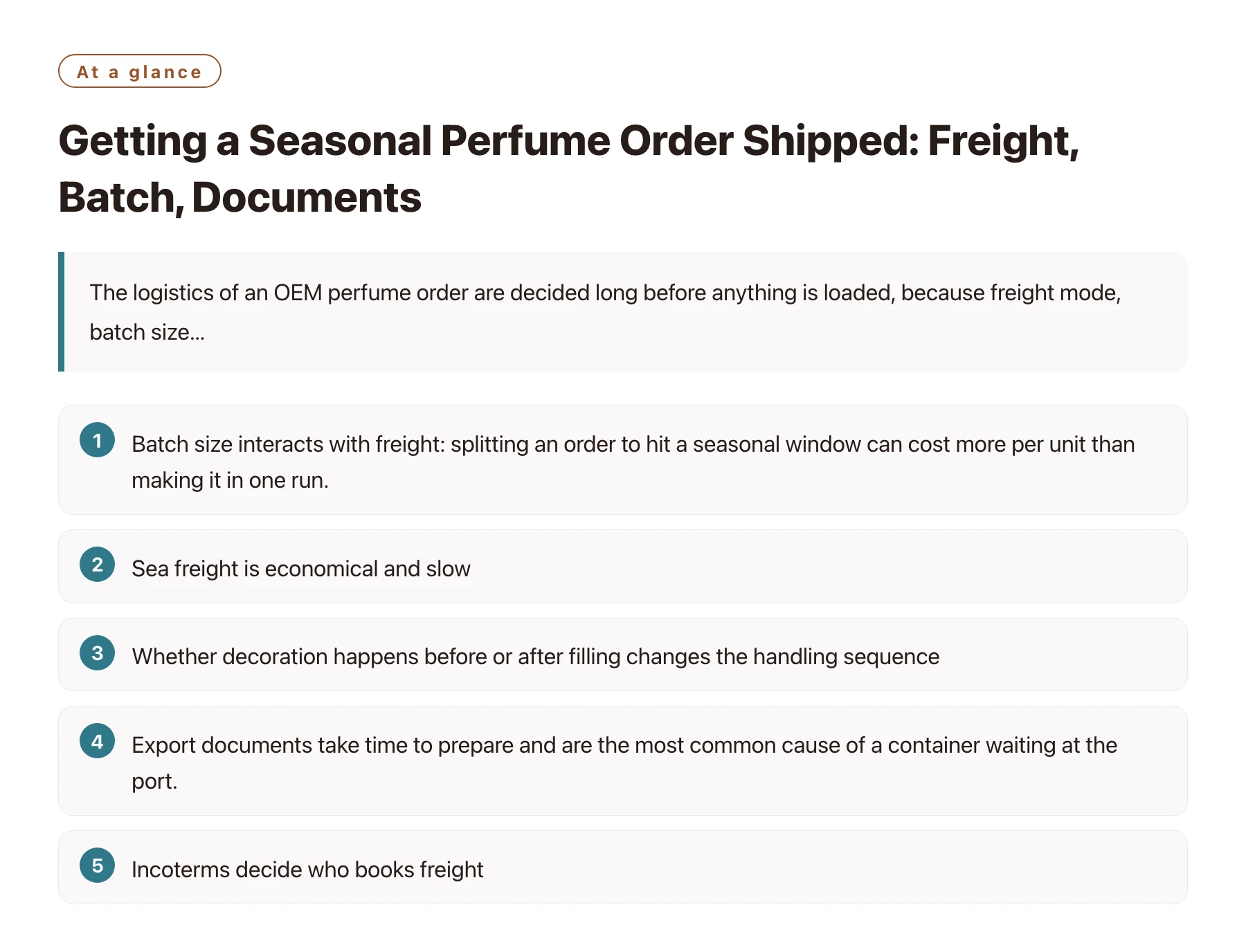
Key takeaways
- Batch size interacts with freight: splitting an order to hit a seasonal window can cost more per unit than making it in one run.
- Sea freight is economical and slow, air freight is fast and expensive, and the decision is usually forced by how late the approval lands.
- Whether decoration happens before or after filling changes the handling sequence, the rework risk and the shipping schedule.
- Export documents take time to prepare and are the most common cause of a container waiting at the port.
- Incoterms decide who books freight, who carries the risk in transit and who clears customs, so they belong in the quotation comparison.
- Seasonal capacity is not evenly distributed through the year, and production and shipping calendars around major holidays should be treated as fixed constraints.
Buyers usually think about logistics after the sample is approved, which is the point at which the least flexibility remains. By then the formula is fixed, the decoration artwork is nearly fixed, and the launch date is closer than it looks, because the final weeks are consumed by inspection, packing and port handling rather than by production.
The alternative is to treat the logistics decision as part of the sourcing decision. Freight mode, batch split, packing format and document responsibility all have cost implications that belong in the same comparison as the unit price, and all of them can be discussed before a single sample exists.
What follows is a set of trade-offs rather than recommendations, because the right answer depends on the season, the margin and the risk a brand is willing to carry.
The trade-off table buyers should fill in early
The table below covers the decisions that most often move a seasonal order out of its window. Two columns are enough for each: what one option buys you and what it costs. The point of writing it down is that a supplier can then quote against a plan instead of against an assumption. Mapping the sequence from from formula to finished bottle first makes it obvious where freight sits in the chain and how little slack remains at the end.
Four logistics decisions and what each one costs
| Decision | Option A and what it buys | Option B and what it costs |
|---|---|---|
| Freight mode | Sea freight: lowest cost per unit and a predictable schedule, but five to seven weeks of transit for many routes | Air freight: days rather than weeks, at a multiple of the sea rate, which can erase the margin on a small seasonal run |
| Batch structure | One production run: fewer setups, lower unit cost, and a single inspection point | Split runs: earlier partial delivery and cash flow, but more setup time and two inspections to manage |
| Decoration timing | Decorate before filling: fewer handling steps after the liquid is in the bottle | Decorate after filling: useful when artwork is late, but it adds a handling stage with a filled bottle |
| Delivery terms | FOB: the brand controls freight booking, visibility and cost, and carries the coordination work | DDP or similar: the supplier arranges more of the journey, at a price that should be checked line by line |
| Packing format | Retail-ready cartons: faster to the shelf, more volume and more packaging material to declare | Bulk packing: cheaper to ship, but it moves assembly and boxing to the destination |
Fill the table in before the quote, not after. A supplier quoting sea freight against a plan that actually requires air freight is quoting a product that will never be produced.
Why documents hold up more shipments than production does
Cosmetic and fragrance products cross borders with paperwork attached to the goods, the formula and the packaging. The document set varies by market, which is why the same shipment can clear smoothly in one destination and stall in another [1]. Destination authorities publish their own requirements, and a set prepared for one market does not automatically satisfy the next one [2]. The practical consequence is that document responsibility should be assigned to a named person on both sides, with a checklist and dates, rather than left to whoever is managing the freight booking. It also helps to ask what a supplier has shipped before: the practical detail behind its background and certifications usually tells you which markets it has prepared documents for and which it has not.
Transport classification is a separate strand. Products containing alcohol and other regulated substances need correct classification and safety documentation for the mode of transport, and the international framework for chemical safety and controlled movement is extensive enough that this is supplier work rather than brand improvisation [3]. Ask who prepares the classification documents and how long it takes.
Packaging rules add a third strand that is easy to overlook because it concerns material rather than product. Packaging waste obligations in a destination market can affect what you may ship and what evidence you need, and these requirements have been tightening [4]. Seasonal gift packaging, which often uses more material than a standard carton, is exactly where this becomes a live question.
Seasonal capacity is not evenly distributed
Two calendar effects hit seasonal launches. The first is that production capacity tightens in the months before a major selling season, because every brand on the same calendar is asking for the same window. The second is that production and freight both slow around major public holidays, so a schedule with no buffer can lose a week without anyone making a mistake.
The response is not to book earlier for its own sake but to identify the last safe decision point. Work backwards from the shelf date: retail delivery, customs clearance, transit, inspection and packing, filling, decoration, component arrival, sampling and approval. The date on which sampling must finish is the number that governs everything else, and it is usually months earlier than founders expect.
It also helps to separate the products that must ship together from those that can follow. A gift set and a single bottle may share a fragrance and not share a deadline. Splitting the shipment reduces the chance that one delayed component holds the seasonal range, and it creates a natural first delivery to inspect.
Comparing suppliers on logistics, not only on price
A unit price comparison that ignores delivery terms is not a comparison. Ask each candidate to quote the same Incoterm, the same freight mode and the same packing format, then compare. If one supplier can only quote delivered and another can only quote ex-works, ask both to provide the missing version rather than reconciling the numbers yourself.
Then ask the operational questions. Who prepares the shipping documents, who books the freight, who handles a customs query and who pays for storage if a container is held. Ask what happens if the decoration is a week late: does the container move empty, does the order wait, and who absorbs the cost. A supplier that can describe the sequence from formula to finished bottle and name the points where a shipment can be delayed is easier to plan with than one that quotes only a transit time.
This is where a single partner covering production and packing is worth weighing against a lower quoted price from a trader. Fewer handovers reduce the number of places a document or a pallet can be delayed, and for a fixed seasonal date that reduction is often worth more than a small saving per unit. Buyers who want to compare the whole route can start with contract perfume manufacturing in China and check how each candidate describes its production and packing arrangements before the first sample is made.
Agree the ship-by date in writing at the same time as the sample schedule. A ship-by date that appears for the first time after approval is a target, not a commitment.
Sources
- European Commission: Cosmetics in the EU —— The European Commission's overview of EU cosmetics rules, including the responsible person, product information file and safety report requirements.
- Health Canada: Cosmetic Safety —— Health Canada's cosmetics pages, covering cosmetic notification, the ingredient hotlist and safety requirements for cosmetics sold in Canada.
- UNEP: Chemicals and Pollution Action —— The UN Environment Programme's pages on chemicals management, including the sound management of chemicals in products.
- European Commission: Packaging Waste and the PPWR —— EU rules on packaging and packaging waste, including the Packaging and Packaging Waste Regulation requirements on recyclability and design.
Frequently asked questions
How far in advance should a seasonal fragrance order be booked?
Work backwards from the shelf date and count sampling, decoration, filling, packing, inspection and transit. Most seasonal ranges need to start development three to five months before the range is due on shelf, and longer when new tooling or complex decoration is involved.
Is air freight ever worth it for a perfume order?
It can be, when a launch window would otherwise be missed or when a small quantity is needed for a specific retail commitment. The cost is a multiple of sea freight, so it should be treated as a contingency with a budget line rather than a default.
Which Incoterm is best for a first fragrance order?
There is no single best term. FOB gives the brand control of freight and visibility but requires coordination capacity; delivered terms reduce coordination but need the price breakdown checked. What matters is that every supplier quotes the same term.
Who is responsible for export and customs documents?
The supplier normally prepares the commercial and transport documents, while the brand remains responsible for market-specific registration and labelling. Assign a named owner on each side, because document preparation is the most common reason a cleared shipment waits.
Does packaging regulation affect fragrance shipping?
It can. Packaging waste rules in a destination market may affect the materials you may use and the evidence you need to hold, and gift packaging tends to use more material than standard cartons, so it is worth checking before artwork is finalised.
New recipes, reviews, and rants — every Thursday.
Join 47,300 home bartenders getting our editor's pick of the week.
Join the Boobar Club or browse the recipe index →